What Asbestos Testing Tells You
Asbestos testing establishes whether a sampled material contains asbestos. It is useful when a facilities manager, landlord or contractor encounters an unidentified product and needs reliable evidence. Appearance, colour and a photograph cannot confirm the presence or absence of asbestos.
The result applies to the specimen tested and its recorded location. It does not automatically cover every matching-looking panel, the whole room or the entire building. Good sampling records are as important as the laboratory certificate because they connect the result to a material someone can find again.
Sampling In An Occupied Building
Sampling needs a competent person and a method appropriate to the material and surrounding activity. It can disturb the product, so it is not something to ask maintenance staff to do casually. Leave suspect material in place and describe the location without cutting, drilling or breaking it.
When making an enquiry, explain whether the building is occupied and whether the material is intact, damaged or already disturbed. Schools, offices and production spaces may need access windows that keep other people away from the sampling position. Tell us about any live services or equipment that could affect access.
The inspection should consider whether a single targeted sample answers your question. A patchwork of different finishes, alterations or separate construction phases may require a wider investigation. If you need a record for the whole premises, a survey is usually more useful than a stand-alone test.
From Site Sample To Laboratory Result
The first step is agreeing the question to be answered. Provide any existing survey reference, room name, plan and intended work so the sample can be identified in context. A clear description reduces the chance of testing one product while the contractor later disturbs another.
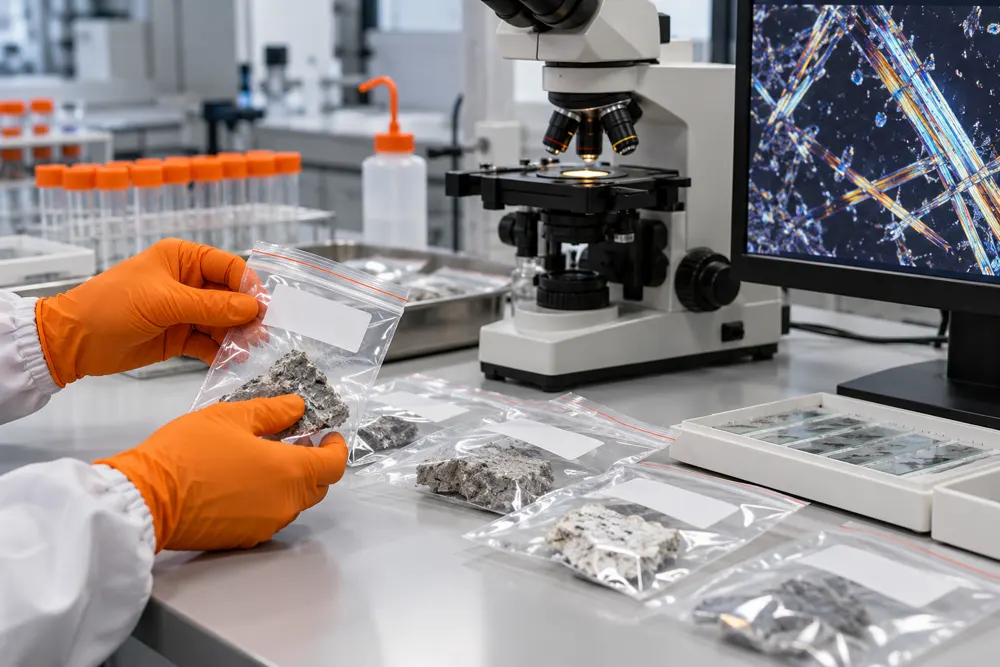
A competent sampler selects an appropriate location and uses controlled techniques. The specimen is contained and labelled so it can be tracked from the premises to the laboratory. Any necessary protection of the sampled point should be addressed as part of the attendance.
The laboratory then analyses the specimen and reports its findings. HSE publication HSG248, Asbestos: The Analysts’ Guide, provides the relevant analytical guidance. Ask for a laboratory with UKAS accreditation covering the actual testing activity and check that the certificate identifies the tested sample.
Reading A Positive Or Negative Result
A positive result should be considered alongside the condition and use of the material. It does not, by itself, tell you whether removal is necessary or whether the work is licensed. Those decisions need a suitable risk assessment and knowledge of what could disturb the product.
A negative result is useful evidence for the sampled material, but cannot erase uncertainty elsewhere. A floor finish can contain different layers, repairs or adhesives, and a sample may not represent each of them. Read the sample description and any qualifications in the report before authorising work.
If the result conflicts with an earlier register, keep both documents and seek clarification. Do not simply delete a recorded asbestos item because a new sample was taken nearby. The locations, material boundaries and reasons for any change should be traceable.
Testing Is Different From Air Monitoring
Bulk material testing and air monitoring answer different questions. A material sample checks the composition of the product, while air sampling examines airborne fibres under defined conditions. An air test cannot identify all the asbestos-containing products hidden in a building.
If material has been accidentally disturbed, stop work and prevent access to the affected area. A competent assessment is needed to decide what investigation, cleaning or monitoring is appropriate. Do not rely on a normal-looking room or an isolated result as permission to restart.
For planned works that open the structure, our refurbishment and demolition survey service provides a broader investigation of the agreed work area. For questions about airborne fibres or removal handover, see our air testing page. Choosing the right investigation avoids paying for a result that cannot support your decision.
What Affects Testing Cost?
The cost of testing depends on the number and type of samples, access needs and the reason for attendance. Sampling a reachable panel in an empty office differs from accessing a service riser beside live plant. Laboratory turnaround requirements also need agreeing before the work is arranged.
A quotation should distinguish site attendance, sampling, analysis and the written result. Explain whether you also need advice on updating the register or planning follow-on work. Send photographs only if they can be taken safely, and do not handle the material to produce a clearer image.
Your Questions Answered
Can You Identify Asbestos From A Photograph?
Asbestos identification cannot be confirmed from a photograph because many materials look alike. A photograph can help explain the location and access conditions, but laboratory analysis of a representative sample is needed to identify the sampled material. Do not break a product to expose its layers or collect a specimen yourself for an enquiry.
Does A Negative Asbestos Test Clear The Whole Building?
A negative asbestos test relates to the material represented by the sample, rather than every part of a building. Different layers, repairs and products can produce different results. If your decision involves an entire premises or intrusive works, arrange a survey with an agreed scope instead of relying on one isolated material test.
Further guidance: HSE: Sampling And Analyst Competence · HSE: HSG248 Analysts’ Guide.